
The Secrets of Our Success?
THE GLIB ISSUE: Better in a cardboard box than on the street eh!
The following journal entry may seem extreme and hard to read, for which I apologise, but it is reflective of what is a day-to-day struggle in this area. My intention is not to battle against the people responsible for creating the problems, but to work with them in terms of understanding and trying to figure out practically what can be done to help them, by which we then help the rest of the community. One thing that is noticeable in the interactions that I have recorded towards the end of this piece, is that no matter how far down a hole a person may have fallen, an appreciation of art is always there, sometimes accompanied by elements of their own creativity, even in the darkest of moments. At our lowest ebb our own imagination can be a life raft, manifesting itself in a whole manner of different ways, carrying us along until at some point we may hopefully set our feet on dry land once more. I come at this not from the point of view of a rich person looking down on those around me, anyone who has visited our venue/home at any point in the last fifteen years will understand what I mean, but as a person who has struggled on a week by week basis to keep a roof over his head and food on the table for the last twenty-six years, and without the earning ability of my wife and Basement board member Debs would not have succeeded in this act at all. We have however not only managed to do this but at the same time we have managed to keep the Basement going for fifteen of those years, quite often financing projects along with the artists, and now our Substack subscribers as well, where we can and always working for free.
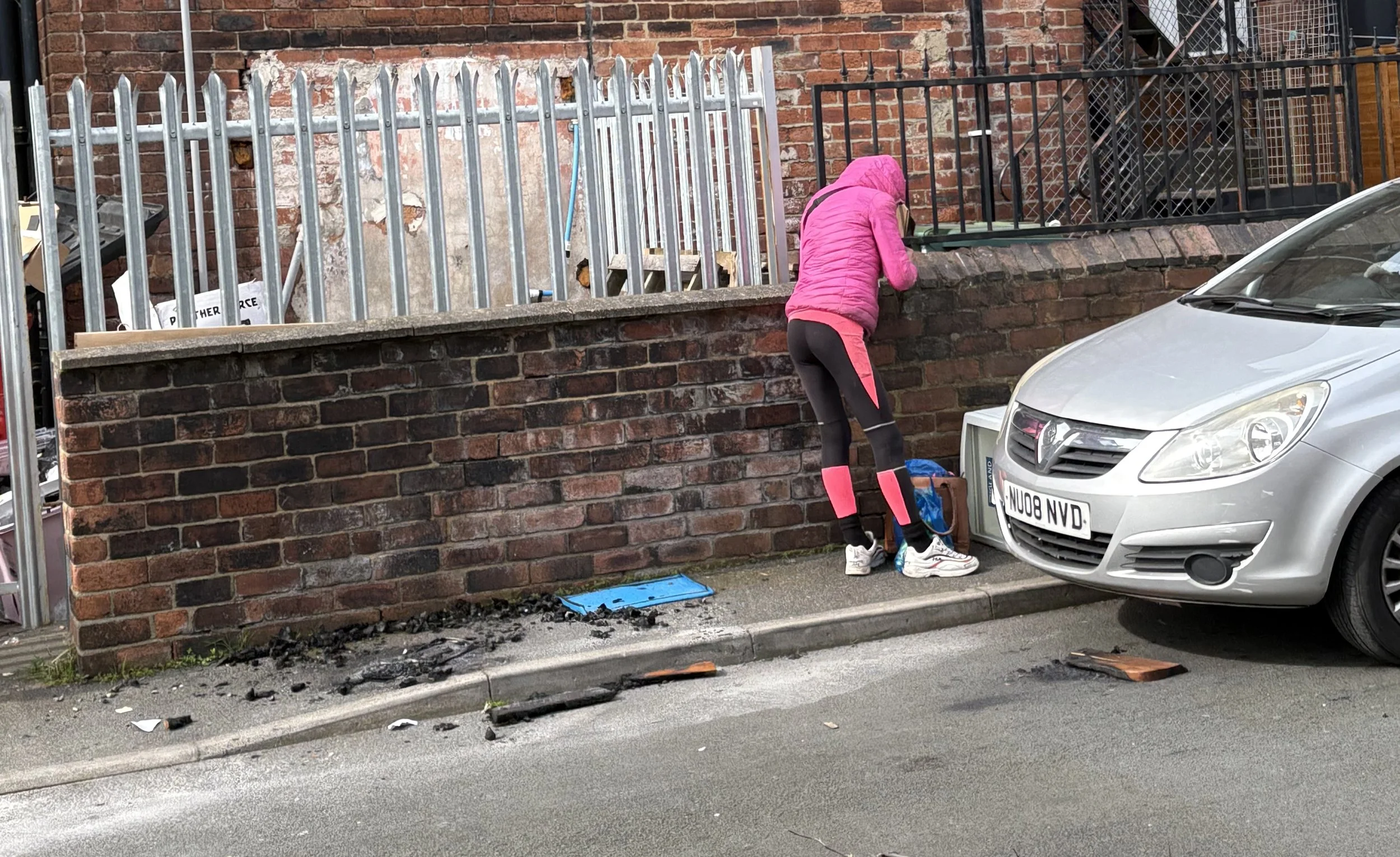
It is easy to tell whether or not the heroin, crack, spice etcetera, is flowing as it should be locally, based on the ambient sound-world of this South Leeds neighbourhood. I am often awoken at around 3:30am, just as daylight starts to gild the summer skies, by the harrowing cries of those that have not managed to fix overnight. The individuals Jonesing, often quite literally, on my doorstep, emit howls that merge with a pitiful sobbing as they struggle to manage the pain of a shift that has yielded nothing. Those who succeeded will be sleeping off their drug induced torpor until the sun is way over the yard arm, before they emerge to begin the new working day again. Life is a battle and if you are not successful you will feel the pain of that failure to succeed. Stepping beyond the door each morning into the world of the addict, the evidence becomes clear; the hardened lumps of excrement, passed with difficulty at the edge of the road, indicate a successful shift as opposed to the liquified torrents that pour down garden walls from roughly knee height, indicating that this individual failed to get paid. The stomach cramp and egg-bound bowels of chronic opiate addiction are only given succour by an uncontrollable downpour of intestinal relief brought about by the failure to succeed. Of course when you are homeless and have no access to a lavatory the last thing you need is the inconvenience of bowel movements, so it is best to put in the hours and hope for success. The pattern of survival is the same from the bottom of society to the top, it is only the terms and conditions of pay that differ. At one end of the scale life is possible, even amenable for some, for others, the end will always be near.
It was suggested in a recent conversation that, whilst we had started the ‘Faces and Threads’ project to use art as a vehicle to study issues surrounding the effects of climate change on society, as perceived through the twin lenses of legacy and social media -art being reflective of society rather than a driver- another subject, not entirely unrelated, was begging to be examined; a thoroughly appropriate term, although in my own mind the word hijack kept cropping up.
In a piece that I wrote recently, I referenced an oft-used quote by the late Mark Fisher in which he points out that “For most it is easier to imagine the end of the world than it is to imagine the end of capitalism”. Whilst my introduction to this third text relating, somewhat tangentially, to the ‘Faces & Threads’ project may seem something of a nauseating side quest to the subject of climate change, I promise you it isn’t, please allow me to elaborate further…
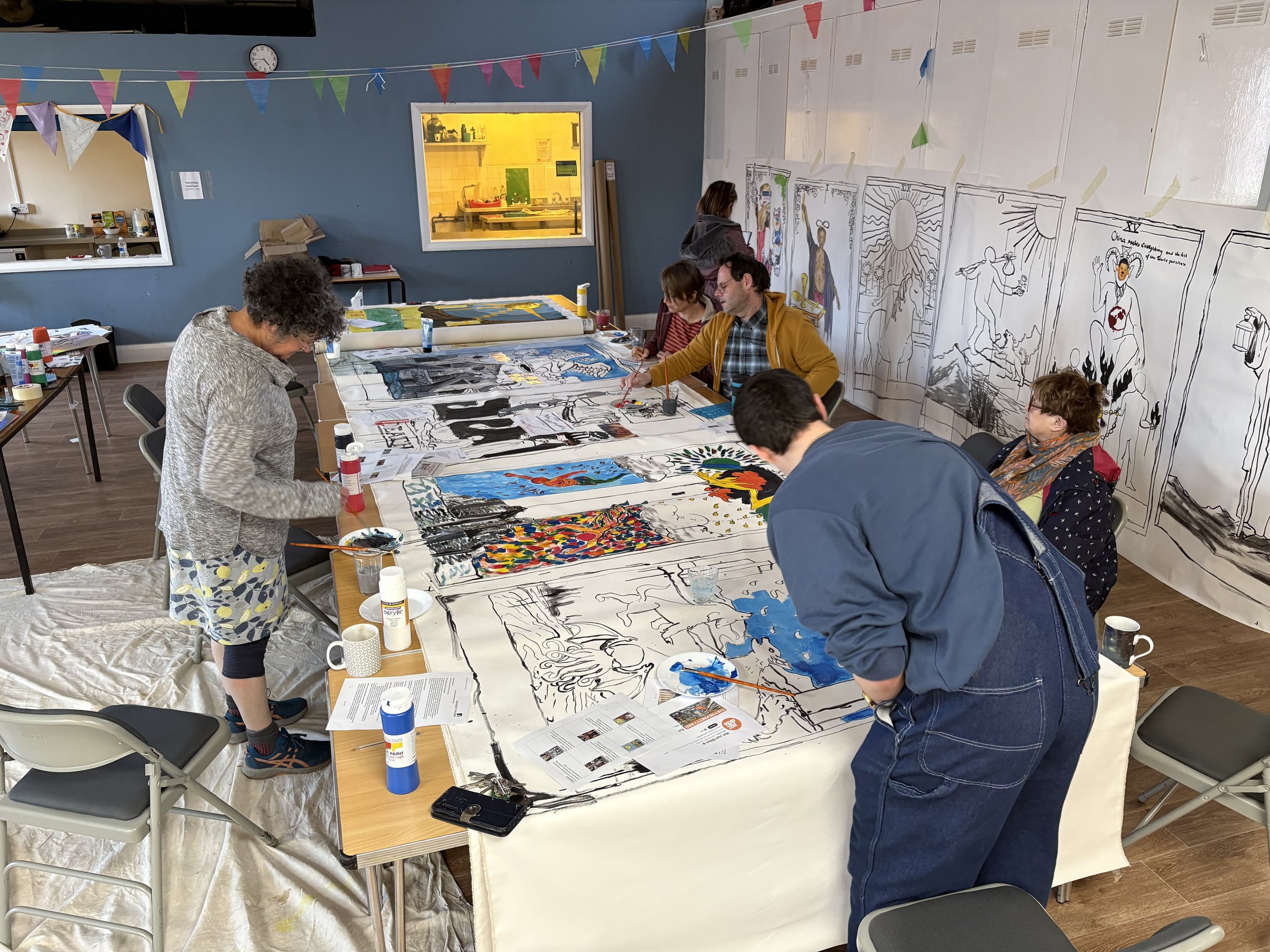
The workshops produced by Lone, Parham and Chris in collaboration with BasementArtsProject and Involve Learning Centre here in Leeds, and in Manchester with Longsight Art Space, did indeed produce some interesting, educational and thought provoking discussions -along with some brilliant work. The resultant exhibitions presented the work in some very unusual and large scale formats: huge 10-15metre painted and collaged canvas’ strung around three large sycamore trees on ‘The Corner’ Pocket Sculpture Park and against the palisade fencing surrounding `The Orchard’ at Longsight in Manchester. ‘The Corner’ is our self-built sculpture park opposite ‘The Basement’ and was itself a project from 2019 designed to take an ecologically sustainable attitude towards the abatement of anti-social behaviour and the environmental debasement of inner-city land wrought upon the community by irresponsible corporate land owners, it has, to all intents and purposes, been successful. That is not to say that we have cured the ills of this community, that is not possible and it is not the job of art to do so, but… as mentioned earlier on, art can provide a signpost reflecting the present whilst guiding us to a more hopeful future, and that is what it has done.
For every forward step we must move two to the side in our quest to stay ahead of the agents of chaos. Avant-garde is a term that is used in both military and artistic contexts, and it is not coincidental. In both contexts it refers to the advance guard, the ones going in ahead to clear a path for all of those who come after.
This piece of writing comes after the first period of destruction wrought upon this project by members of a nearby drug encampment. During this the paintings were pulled down and ended up defaced with human blood and vomit. Not to be beaten I put a call out to the art community in Leeds and asked for help to get the display back up. On days where my positivity struggles it is my depths of my ire that gets me out of bed in the morning.
I am joined across two days by Parham Ghalamdar; the artist involved in the project, Alan Reynolds the organiser of the South Leeds Artist Collective, from Assembly House in Armley; Alice, Jacob, Phee and Gabe and from Basement’s own junior team; Ev, Frank, Lol and Charlie. The day involved much stitching of tears in the canvas, cutting out sections featuring elements that we didn’t really want to have touch, repainting old sections and adding new…
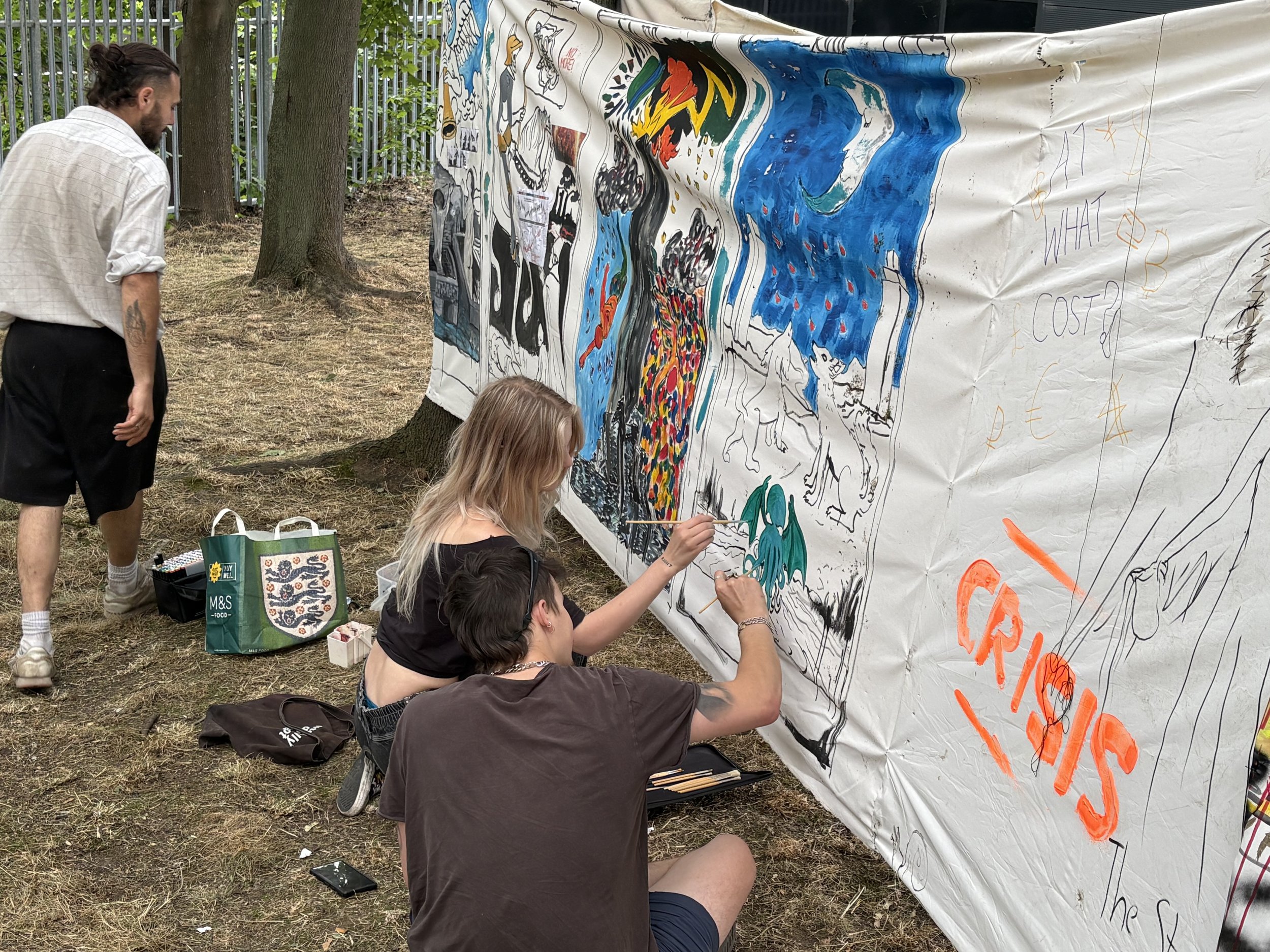
To all involved a BIG THANK YOU
[Sadly it did not last too long as I returned from a ten day sojourn on the coast to find it down again. This time due to a new exhibition -The Sonder Archives vol II- there was no time to repair, remake and rebuild so I folded the work and put it away to await installation in The Basement for Parham’s exhibition. But in the time between artapocalypse I & II a different aspect of this project was revealed and foregrounded, mainly by chance.]
Towards the end of the first day of repairs I am working with Alan Reynolds of the South Leeds Artist Collective on the newly re-instated canvas, this time strung between two trees to hopefully make it less of a target. As we are stitching and painting and cleaning we are approached by a regular user of the land. She has no legs and often sits here in her chair. She tells me about her ground-floor Bed & Breakfast room without running water that she has nearby and how much she likes art. She points out her work nearby at the base of the 5G mast, bus stop and bin. She asks me to play some of her favourite music on my phone - she has a love of Nigerian music. Eventually she packs her belongings into the bag strung across the back of her wheelchair and heads off back towards her B&B further down the road.
[The B&B was recently raided and closed down on drug dealing charges. I have not seen her since.]
On the second day after everyone has gone home and I am on my own taking a few photos of our handy work, I am approached by a guy who has been, looking at one of the newly installed, free hanging pieces. He tells me about his spiritual awakening and how much he likes to do art. He makes models of swords using wood that he finds lying about. He tells me that our work makes him think about how wrong the world is and how destructive everybody is. He sits for a while on the grass before he heads off down the road.
Sitting in my garden, an entire street away later on, I am approached by a Nigerian gentleman in a lime green sports jacket, purple shirt and blue jeans. His name he tells me is L_________ and that he is an artist. He says in very broken English that he loves the depiction of 9-11(the man falling off the tower). I tell him that it is not a depiction of 9-11 but is part of a project on climate change. He tells me that everybody is stupid, listening to that little girl about climate but that she not only knows nothing because she is a child but also because she is a girl. ‘You mean Greta Thunberg’ I say. ‘Yes her, she should be in school learning’ he says. He mentions the President. ‘Donald Trump is not the most accurate or reliable source of information though’ I respond. ‘But he is the President, so he knows what he is talking about’ he responds. His comments drifts back to 9-11 and verge on the obsessional before he tells me to look at his Facebook page where his art is and he wanders off.
[I go and look at his Facebook page]
Later that evening I head out to the supermarket behind ‘The Corner’ to get something for tea. Outside are two recent regulars -denizens of the encampment on the other side of the road, some of whom have been responsible for some of the bad behaviour on ‘The Corner’- The woman tells me her name is J________ and she tells me she saw me working on the land earlier and that she loves art. She is a poet. She asks if I would like to hear one. ‘Yes’ I tell her. She reads me her poem about a next door neighbour treating her with suspicion when she went to ask if they had a cup of sugar that she could borrow. She is homeless now. I ask her why the edges of her notebook, a rather nice red faux leather one, is burnt around the edges. Some b*****d set fire to my tent and my notebook was in my sleeping bag so I had to go in and get it… burnt my hands in the process. I don’t even have a tent now. And I lost all my paint and pencils. Her colleague J_____ is a whirling dervish, careening around the doorway of A___ offering to take peoples trolleys back for the pound and chattering about how J____ is a witch and that it is her insight that has led them to find useful things that others have thrown away but that are useful to them.
The next day I take J____ a spare unused brown leather bound notebook and some pencils, paints and brushes that I have around the house and give them to her. She thanks me and asks if I can buy her a sandwich.
[Two days later I see her in the overgrown pathway behind the local P*******d engaged in some kind of ‘exchange’ with a youth in a balaclava on an e-scooter. I am assuming a youth despite not being able to see his face due to his style and build.]
[I have not seen either for the better part of weeks now]
Two weeks after the second period of art annihilation, having removed the paintings altogether this time, I am litter picking on the land, it is not that bad anymore, just stuff that has blown in off the street from the nearby overflowing bin. There are signs of a small shoddy picnic near the back of the land; sandwich and crisp wrappers and half drained pop bottles left under a tree, but thankfully no more needles or spoons. The encampment across the road has been moved on, although a couple have since moved back and are living under a bedsheet tied between two trees at the back of the car park. As I am picking the remains of the picnic I am approached by a woman [of indeterminate age] who asks me ‘is this your job?’ I tell her that it is not but I am trying to keep it nice as a place for people to sit. So you don’t get paid? No, I respond. She tells me about her daily pipe of crack, cancer diagnosis and lack of energy but how good it is to see people who are trying to make it a nicer place. I chat with her for a good half hour and eventually she tells me “I’m K_____ its been nice to chat to you, can I get a hug” Of course I say, giving her a hug before she sets off for home, wherever that may be.
Back in the very early 2000’s, when I first moved to South Leeds to attend Leeds Metropolitan University, there was talk that one day South Leeds would be totally swallowed up by the city and that it would become a part of the LS1 postcode. Whilst the the rumour was no doubt apocryphal it is interesting to see where things have gone in the years since. Development is like a glacier, characterised as moving out from the city centres up and down the country, bringing the riches of the city to the outer reaches. Typically though, just like the slow moving glaciers, the riches melt away as they move away from the centre. The terminal moraine can be seen in a ring around the city, the point at which Leeds BID cease their cleaning and improvement activities and we see the change from clean jet washed streets to the human faeces spattered remains of the land that development forgot. Meanwhile the city returns to the beginning of its cycle of constant renewal.
For some the end is closer than others. Whilst the existential dread of the heat death of the universe may frighten us on behalf of our as yet unborn children, yes this dread does affect me as I too have children, for others the end could come tomorrow in any shape or form; hunger, cold, overdose, or in the case of the chap that I used to sit and talk to in his tent under Dark Neville Street a few years back, Carbon Monoxide poisoning (from living in a tent in a tunnel on one of Britain’s most polluted stretches of road outside of the capital. This changed during lockdown when the air quality improved tenfold due to a lack of traffic and it has remained low ever since due to the diversion of traffic away from the centre. Now the pollution runs instead through the poorer outskirts of the city). When I asked him if he had tried to find a place in a local hostel he told me he hated it and could not stay in it. Everybody stole each other’s belongings and nobody talked to each other, at least out here on the street people stopped to talk.
If we are to succeed as a society we must understand each other’s positions and know that we have to bring people with us, not under duress but with compassion, understanding and the willingness to engage with literally every situation that life throws at us.
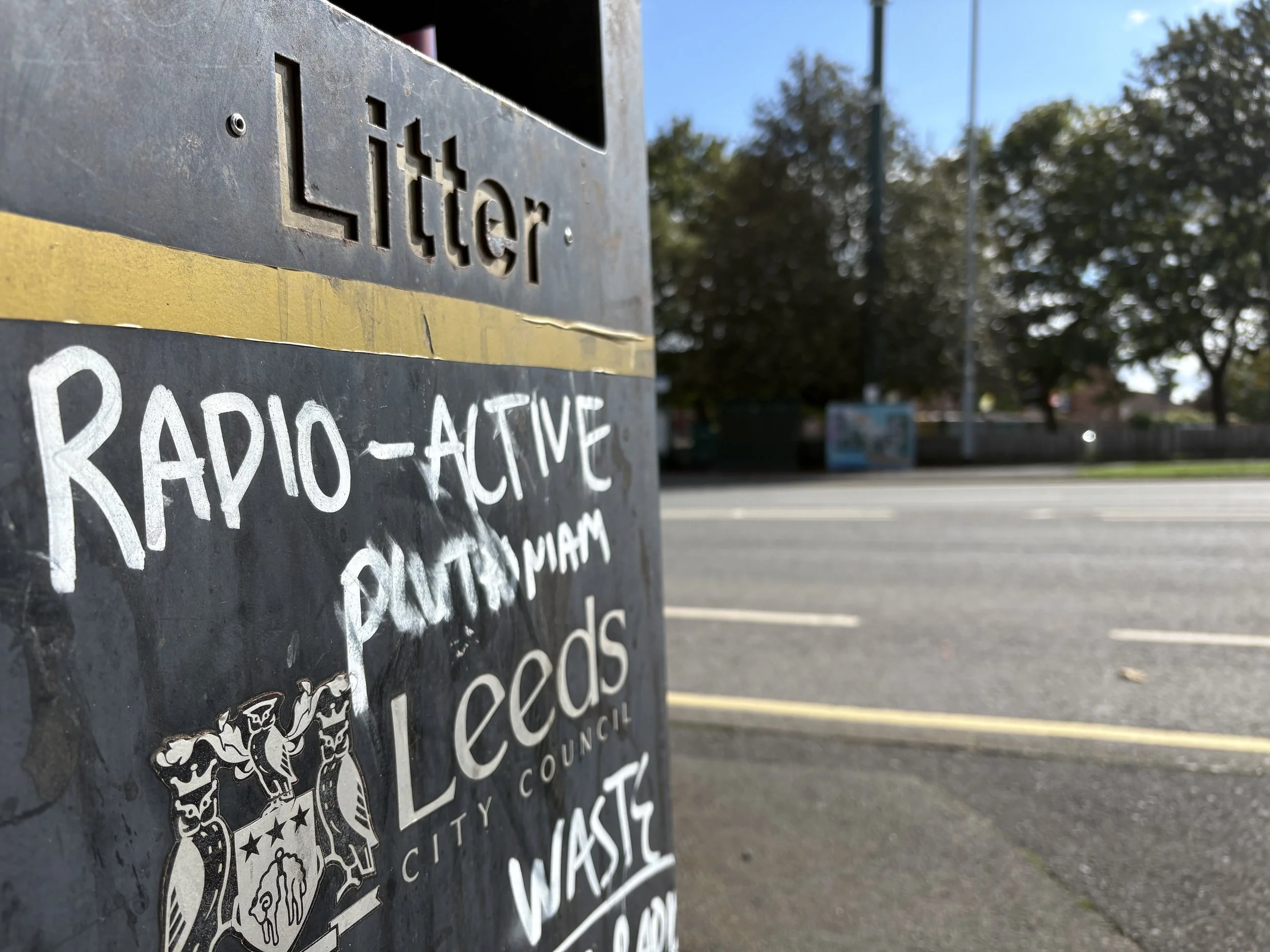
Postscript: at the time of writing, a new Microsoft AI Data Centre has just been given the green light to go ahead here in South Leeds. The proposal was given the go ahead despite the concerns of the residents of Middleton. It is recommended that data centres, regardless of any environmental concerns such as their thirst for an endless supply of clean water, are not built within a quarter, or ideally half a mile of residential areas due to the intense low frequency hum of cooling and back-up systems. We only have to look at the Astley Warehouse development over in Wigan to see how that works out. Once again the needs of the immediate community, one that already lives with significant challenges to the day-to-day functioning of its people, and more often than not a significantly reduced life expectancy, is ignored alongside the environmental implications which will continue to lead this community down the path that ecological destruction is inevitable and cannot be avoided.
Sign the petition against the centre here
Be sure to come and join us for the opening night to launch the final part of this project on Tuesday 1st September here at BasementArtsProject. we to hope you. can join us…